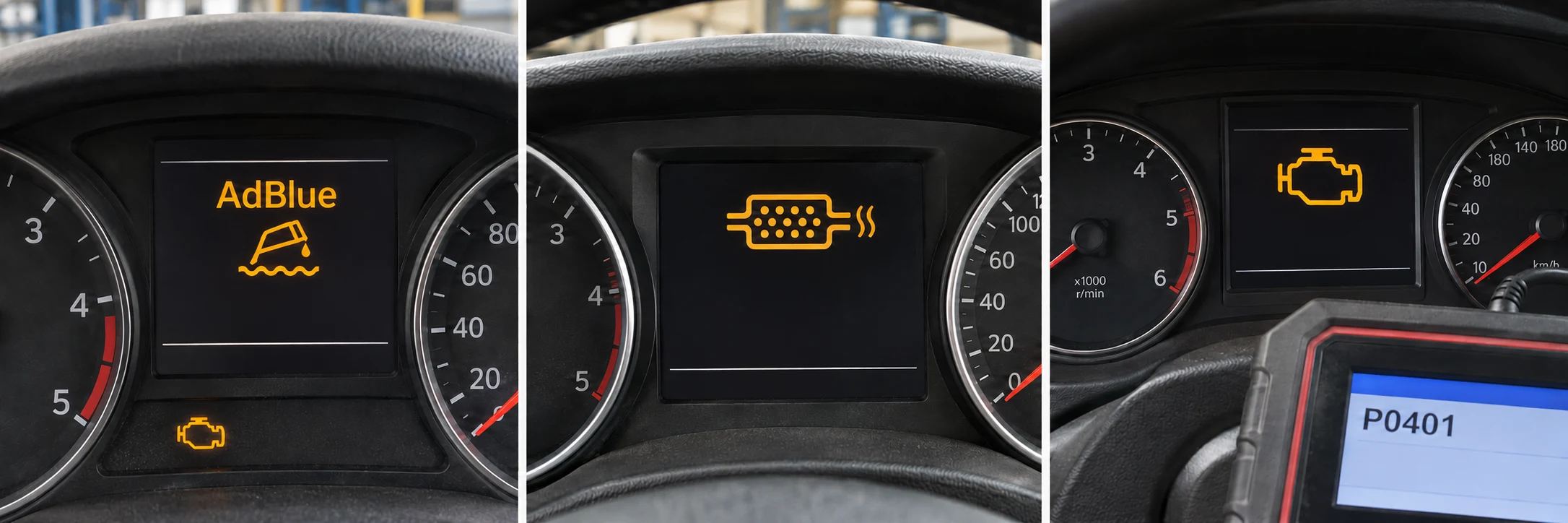
Illustrative dashboard images created with AI. Messages vary by vehicle.
Software deactivation of the relevant function or monitoring (off/delete), not physical component removal. Availability and permitted use are assessed for the specific vehicle and ECU version. A particulate-filter warning can involve loading, regeneration, sensors or earlier software changes. Record complete fault codes, measured values and repairs performed. We then assess the software question; clearing a code does not repair a blocked or damaged filter.
Software deactivation of the relevant function or monitoring (off/delete), not physical component removal. Availability and permitted use are assessed for the specific vehicle and ECU version. Recurring EGR faults can have several causes. Record valve, control-signal and measurement checks and replaced parts. If software was modified previously, we assess the current readout and whether the correct original software can be restored.
Software deactivation of the relevant function or monitoring (off/delete), not physical component removal. Availability and permitted use are assessed for the specific vehicle and ECU version. An AdBlue warning or restart countdown is not automatically a software fault. Supply the exact message, remaining distance, codes and checks of fluid, dosing and sensors. Include previous updates and control-unit identification.
Software deactivation of the relevant function or monitoring (off/delete), not physical component removal. Availability and permitted use are assessed for the specific vehicle and ECU version. SCR combines dosing, sensors and catalyst performance. An efficiency warning requires diagnosis of the complete system. Supply measurements and checks before we assess whether a software request is relevant.
Software deactivation of the relevant function or monitoring (off/delete), not physical component removal. Availability and permitted use are assessed for the specific vehicle and ECU version. A NOx warning can involve a sensor, wiring, control signals or emissions-system performance. Include the full code with manufacturer suffixes, sensor location and previous replacements. A code alone does not identify a failed component.
Does the vehicle run incorrectly after another provider changed its software? Retain the current readout and supply the earlier original file if available. We compare vehicle and software identification and assess availability of the correct original software. Recovery is not always possible.
A DTC-off request concerns software deactivation of specifically identified fault-code monitoring, not repairing its cause or simply clearing fault memory. A P-code describes a detected condition, not necessarily its cause. Record the complete code, status, freeze-frame, vehicle details and occurrence conditions. Use manufacturer documentation for interpretation. We assess software based on the diagnosis; clearing codes alone does not fix recurring faults.
Speed limits may be configured in several units. Supply the current limit, requested setting, vehicle configuration and intended use. We assess options for the specific software version. Tyres, brakes and permitted vehicle use remain essential to safe operation.
Pops & bangs changes exhaust sound through engine calibration; it is not fault repair. Describe the engine, exhaust hardware and intended use. Thermal loading on the catalyst, turbo and exhaust can increase. Availability and permitted use are assessed beforehand.
For starting-authorisation problems, first investigate the key, power supply, communication and control-unit identification. Requests are accepted only from verifiably authorised owners or workshops. Describe the fault and any unit replacement. No bypass instructions are provided.
Software deactivation of the relevant function or monitoring (off/delete), not physical component removal. Availability and permitted use are assessed for the specific vehicle and ECU version. Catalyst warnings can have mechanical, electrical or software causes. Record complete codes, sensor checks, exhaust configuration and previous modifications. We assess restoration or diagnostic support; suppressing a warning does not repair a failed catalytic converter.